027 550 0611
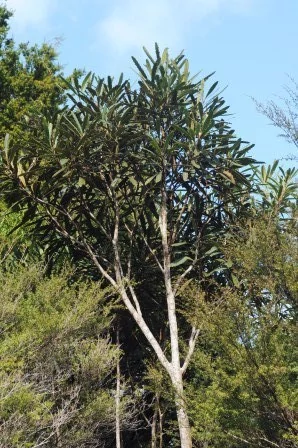 Pseudopanax crassifolius and Pseudopanax ferox – Horoeka
Lancewood in the Tangihua forest are found……
Along most of the tracks and the nature trail and around the lodge and other open areas. Lancewoods do well as they establish in open areas and their leaves make them goat and possum proof.
There are two type of lancewood in the Tanghua ranges
Pseudopanax crassifolius
The common lancewood seen through out the forest
Pseudopanax ferox – Toothed Lancewood
Despite there being 1,000s of the common Pseudopanax crassifolius only one Pseudopanax ferox has been found in the ranges. They rare trees even though found throughout New Zealand. The toothed lancewood is very like P.crassifloius , with the same pattern of growth but
- Grows at a much slower rate.
- The leaves of the juvenile stage are shorter
- the toothed margins are much larger.
- The a\dults do not grow as tall and has shorter leaves.
- The trunk of older plants develop an attractive braided appearance.
See photos taken of the only tree I have found in the Tangihua ranges so far. They can be bought from nurseries
Lancewood trees have a number of unusual features
Lancewood has very distinct juvenile and adult forms, this is called heteroblasty. There are a number of theories as why lancewoods grow like this.
- They developed along with the Moa and juvenile lance wood leaves are unpalatable and once the tree got above Moa height the leaves changes to better absorb sunlight for photosynthesis
- Another theory is that to be able to have access to enough sunlight to fruit and produce seeds they must grow up quickly to get above other competing trees. Once they reach that height they have access to more sunlight and can branch out and have bigger leaves.
Lancewood growth stages
Juvenile lancewood
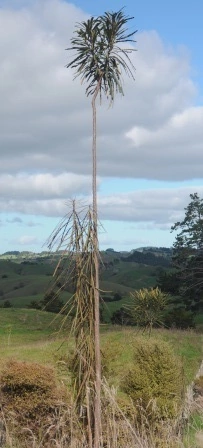
A juvenile lance wood has long thin leaves and a single trunk with no branches, this lasts for between 15 and 20 years. The juvenile leaves are long, narrow and 12 – 20mm in width deflecting downward. The leaves are primarily a very dark green colour with a purple underside. They also have a pronounced yellow-orange midrib occupying almost a third of the leaf area. Distinctive teeth are distributed along the margins of the tough and coriaceous leaves.
Adult lancewood
After about 15 years or when the growing tip gets about 15m from the ground the trunk begins to thicken and tree begins to develop branches at the top. The adult leaves are much shorter and wider, as can be seen in the photos below.
-

- Lancewood juvenile and adult on lodge road.
-

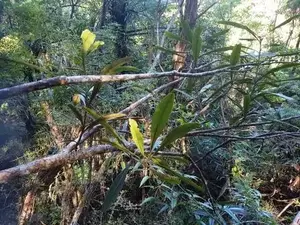
- Adult foliage
-

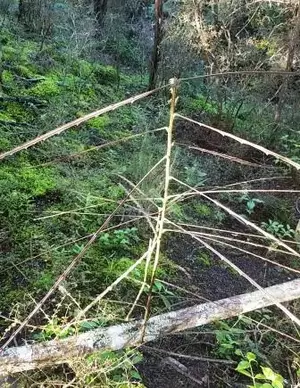
- This Lancewood is horizontal and has juvenile branches sprouting from the trunk and a mature head
-

- Horizontal Lancewood head
-

- Lancewood flower
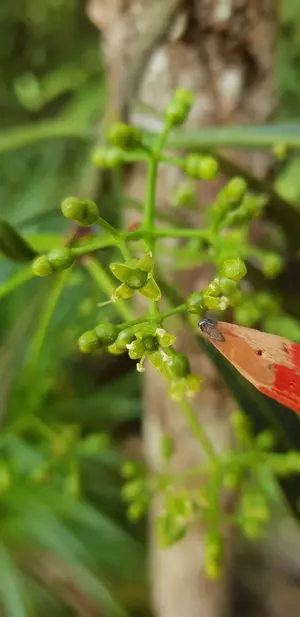
Lance wood description
Lancewood trees grow to about 15m and has a smooth bark, with rope-like ridges in the juvenile form. The lancewood has male and female flowers on the same tree. The male flower having 5 petals, the female with a 4 – 5 celled ovary. Its fruits are globular, smooth & are purple ripening to black over a period of 12 months.
Significance to Maori
South Island Māori pounded lancewood leaves and extracted its long ‘hairs’ for use in a kind of paint brush that was used to make rock paintings. The straight stems were often used as spears