027 550 0611
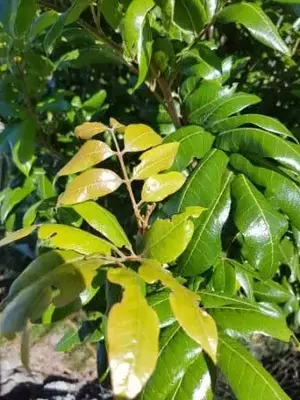
Titoki leaves, the yellow ones are new growth
Alectryon excelsus endemic to NZ
Titoki is endemic to NZ
The Titoki of the Tangihua forest are found……
Titoki Description
Tītoki grows up to 15 metres tall.It is tends to have spreading branches and trunk. the bark is distinctive and often covered in lichens, this with Its twisting trunk with spreading branches makes it a very pretty tree
Tītoki has large compound leaves made up of four to six pairs of oblong leaflets. Its bunches of tiny flowers have no petals – they are a ring of reddish-purple stamens. When mature, tītoki’s woody fruit capsules split open to show a shiny black seed, partly covered in scarlet flesh. The ripe fruits are eaten by birds.
A smaller subspecies (Alectryon excelsus subsp. grandis ) grows on the Three Kings Islands. It is usually multi-trunked, with longer and wider leaflets than mainland tītoki.
Flowers and leaves
Tītoki’s glossy dark green leaves are neatly arranged in four to six pairs on alternate sides of the stem. On some plants the leaves are almost opposite each other.
In spring, its small purple flowers are inconspicuous. The seed is enclosed in a hairy, woody capsule, takes up to a year to mature.The seed capsule then opens to reveal a bright, shiny black seed perched in a fleshy red base.
The Titoki is unusual in that it can flower and carry last year’s seed pods at the same time.
Significance to Maori
its seeds were once highly valued by both Māori and European for its high quality oil,
Tītoki oil was the best quality oil available to Māori but because it was so difficult to extract, it was highly valued for its scarcity. It must have been “the good oil”, because early European watchmakers used it as a lubricant in their trade.
First, the whole berry was collected in kete (baskets), crushed, washed, rinsed, and trampled to remove the clean seeds from the fleshy base of the fruit.
The seeds were then pounded in a solid ipu (basin) with a tuki (pestle) and then placed in a strong elongated bag plaited from green harakeke (flax) leaves. In some references, the crushed seeds were pre-heated in an umu or hot rocks were placed inside the bag to speed up the flow of oil when it was compressed.
Two men with strong cross-poles at each end of the bag then twisted it in opposite directions to express the oil into an ipu below; a similar technique to that used to extract the juice of tutu and other berries or fruit.
The resulting green oil was historically used for medicinal purposes including the treatment of sore or inflamed eyes, wounds and open sores, chapped skin and bruises, sore breasts, and rheumatic joints.
Some sources say the oil is a good skin softener, and it was also taken internally as a laxative.
Sometimes hinu tītoki was mixed with a varity of other plantds and herbs such the gum of lemonwood or steeped with the leaves of heketara (Olearia species), kōhūhū , kōareare , kawakawa , pepper tree,mānuka or scented moss to produce a fragrant scent.
The skin of a pūkeko was immersed in this scented oil, wrapped into a ball and suspended from the neck, or it could be stored in a tahā hinu (small vessel for oil) worn around the neck, to slowly waft its fragrance under the wearer’s nostrils.
The oil was mixed with kōkōwai (red ochre) to kill vermin — presumably fleas or lice infesting the body or clothing. It was very effective, according to one source.
Another source suggests bruising and boiling the leaves of tītoki and rubbing the liquid on the skin to ward off sandflies. To treat sandfly bites, bruise the leaf and use its juice to ease the pain and reduce the swelling — a handy tip if caught in the bush without insect repellent.
According to Best, the Tākitumu people once dried bodies after death by placing the corpse between two thick inner sheets of tōtara bark which had been smeared with hinu tītoki and pia tarata. When the body was dried, pia tarata was smeared over it to close the pores and prevent decay.
In recent years, scientists have found that hinu tītoki contains cyanolipids . An extract from its leaves and twigs is believed to have anti-viral properties effective against the influenza A virus.